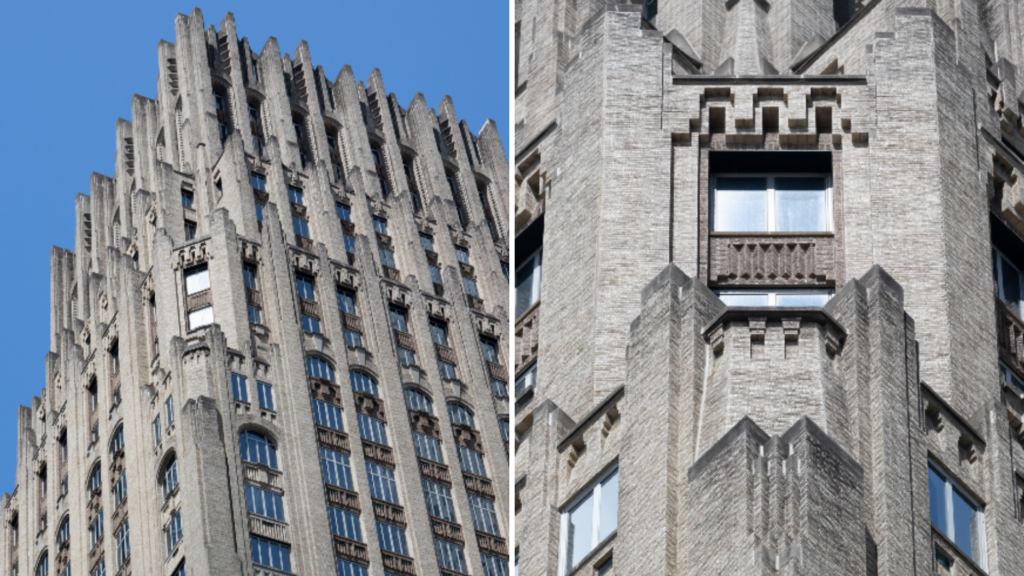
Just two years after “Art Deco” made its debut in 1925, Houston business leaders began planning an iconic structure: the Gulf Building. This exemplar of Art Deco style remains a treasure almost 100 years after it was built. It also marks an early success of a scrappy young company in Fort Worth that supplied the brick.
What This Means for You — Acme Brick has built a rich history on both historically significant structures—office buildings, educational facilities, and sports venues—and the homes of regular families. Each group is important in its own way, and each has allowed Acme Brick to stand the test of time.
Brick construction for commercial buildings and residential construction is timeless in its rich colors and resistance to the elements. Click here for more information on Acme Brick.
Styles in architecture, interior design, furnishings, and building materials have always been cyclical. Art Deco made its debut in the mid-1920s, at the Exposition Internationale des Arts Décoratifs et Industriels Modernes in Paris. The style was nothing short of dazzling, and Art Deco makes a ”return visit” on a regular basis.
According to this source, modern technology enabled “a glamorization of the architecture and interiors. The style reveled in all things new, exotic, glamorous, and dramatic. It was wildly popular until the late 1930s and early 1940s, when its over-the-top ostentation fell out of step with the Depression and World War II.
“Its bold, exuberant colors, decadent high-end finishes, and exotic motifs have surged back in the popular imagination over the years. Art Deco’s celebration of strong geometry, look-at-me-patterns, and rich materials is hugely influential with contemporary designers”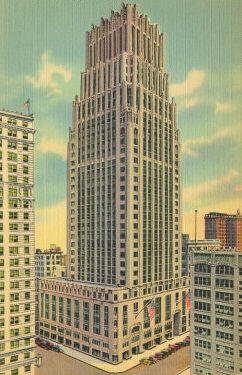
Many have written about the amazing building at Main and Rusk streets in downtown Houston. According to the Texas State Historical Association, newspaper publisher Jesse H. Jones commissioned architects Alfred C. Finn, Kenneth Franzheim, and J.E.R. Carpenter in 1927 “to design a structure of strikingly modern style and commanding height.
“From its completion in 1929 until 1931, it was the tallest building west of the Mississippi. From 1929 until 1963 it dominated the skyline of Houston as its tallest building.”
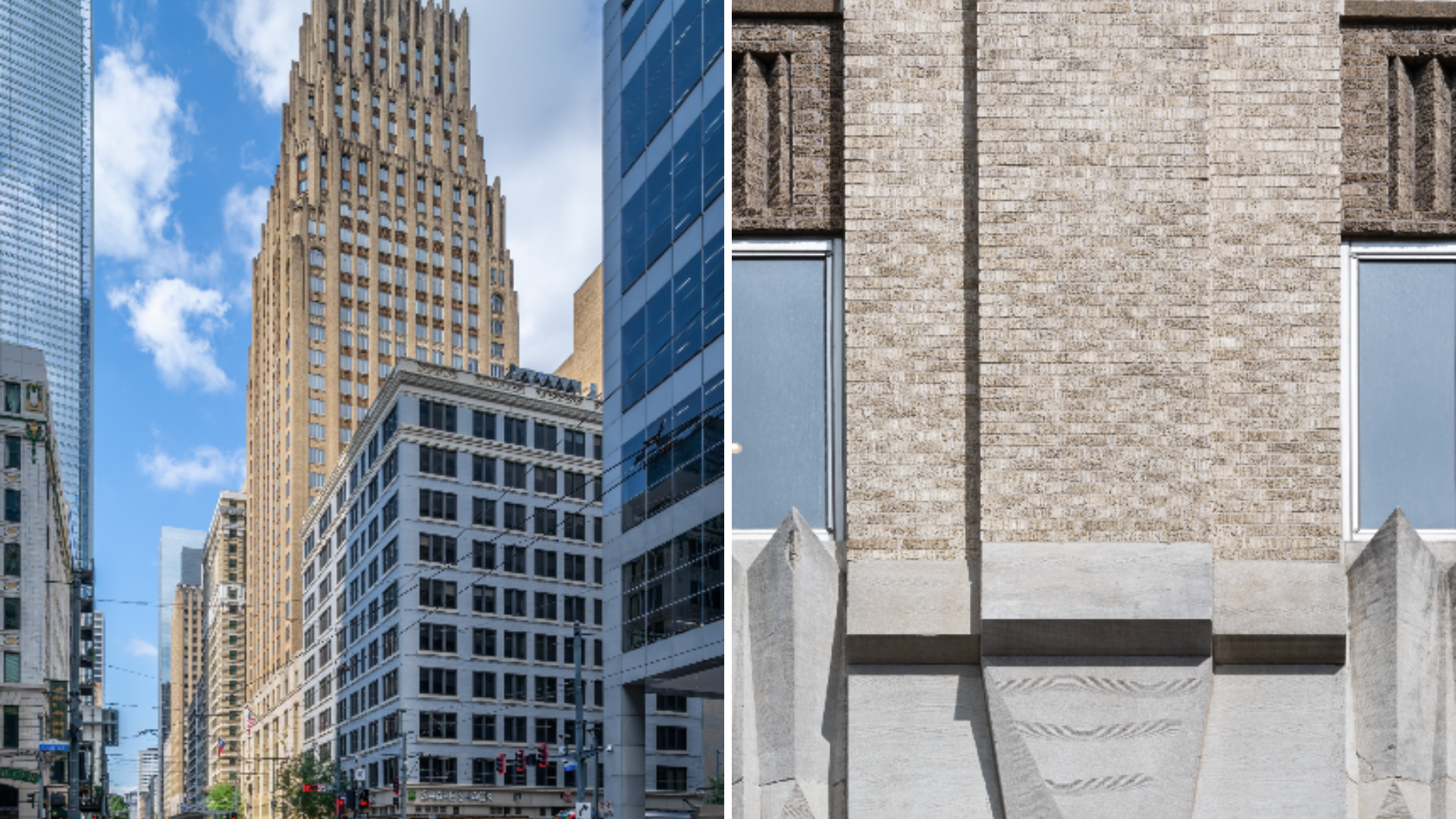
Rising from a T-shaped, six-story base, the Gulf Building “carries a thirty-story tower faced with tapestry brick in Flemish bond. The architects utilized Eliel Saarinen’s stepped profile design, which diminishes in volume as it rises.
“Two annexes were subsequently added in 1946 and 1949, both designed by Alfred C. Finn.”
Between 1981 and 1986, the Gulf Building underwent significant renovation and restoration for its then owner, owner, Texas Commerce Bank. Today it is the Houston headquarters of Texas Commerce Bank’s successor, JPMorgan Chase.
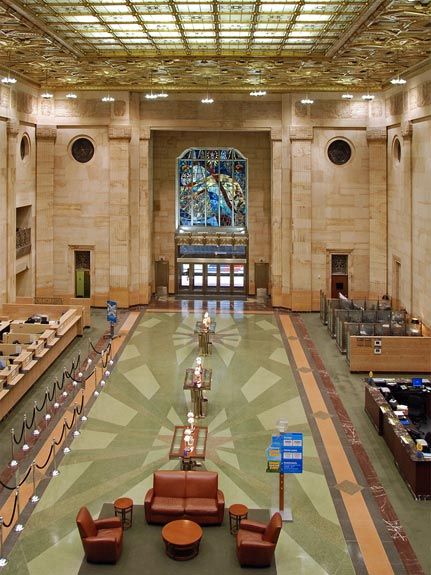
“The observation deck atop the tower housed an aeronautical beacon and a telescope. It is said that on a clear day, Galveston (approximately fifty-five miles) was clearly visible through the telescope. The Main Street lobby is richly decorated with eight frescoes illustrating the history of Texas and Houston, painted by New York artist Vincent Maragliotti, with vaulted ceilings, and with fixtures of decorative polished nickel and etched glass in panels of raised arches, scrolls, rays, and chevrons.
The building added a massive stained-glass window depicting the Battle of San Jacinto in 1960.
“From 1966 to 1974, the company insignia of the Gulf Oil Corporation, an orange 53-foot-high rotating neon disc, replaced the beacon and telescope.”
The building has a total of 800,000 square feet of space. A banking center, on the ground floor, has 43-foot ceilings, floors and walls of marble, and large stained-glass windows.
“The Art Deco style is the same as it was in the 1920s,” Stokes said. “And the building has a remarkably contemporary look and feel. We are very proud to have been a part of this amazing history!”
If your plans include building a commercial building or home, ask your architect to request this pocket-size guide to brick construction.

Thanks for stopping by! We’re constantly working to make Brick.com the best resource for your projects. We’d love to get your feedback about your experience today—it only takes about 60 seconds and helps us make improvements for you.