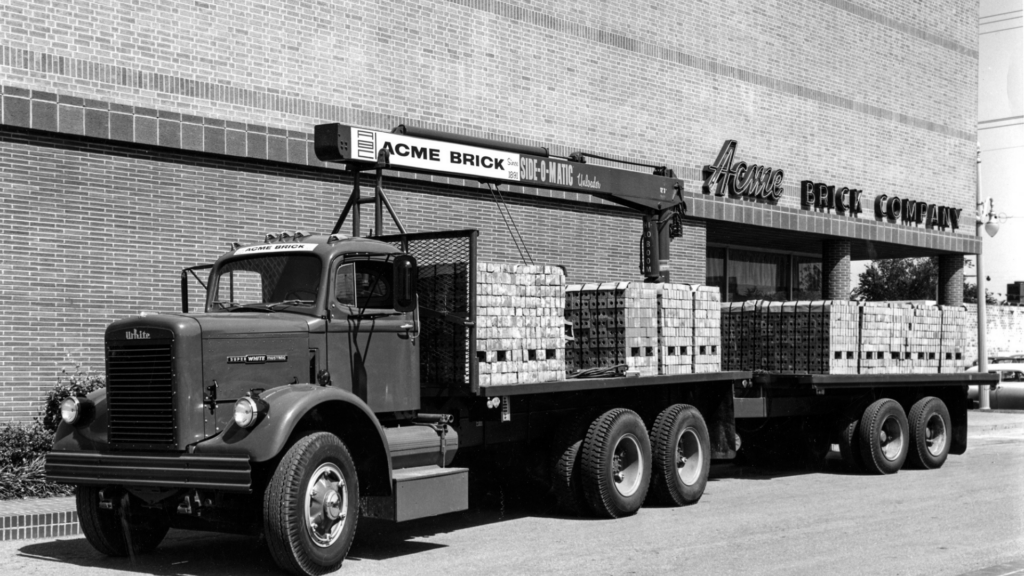
For anyone who was around 130 years ago, 1891 was rough and rowdy. The “Gilded Age” was coming to an end. Railroads were the major growth industry with the factory system, mining, and finance increasing in importance. And Acme Brick history began.
1891 was to see many “firsts” in the United States.
It’s time to take a trip down “memory lane” (made from Acme Brick pavers, of course) Click here to read a timeline of tenacity.
Humans have used brick to build long-lasting structures for thousands of years. According to this source, “Brick dates back to 7000 B.C., which makes them the oldest known building materials. They were discovered in southern Turkey at the site of an ancient settlement around the city of Jericho. The greatest breakthrough came with the invention of fired brick, around 3500 B.C. From this moment on, brick could be made without the heat of the sun.”
Given this ancient history, advances in brick manufacturing that occurred only 130 years ago appear to be relatively recent. However, changes in the brick and construction industries have accelerated exponentially over the course of Acme Brick’s history. It started with a man who built the foundation of a company that is still flourishing and evolving.
A merchant in Dallas, Bennett was a classic entrepreneur. He recognized a growing demand for construction materials in his native state, where people were moving out of the frontier state and building new cities. Log cabins would no longer satisfy home and business owners! First, Bennett found and successfully tested raw material such as clay and shale, which were found near Weatherford in Parker Count. He then developed a business plan around a labor force and railroad transportation for the finished product. Bennett chartered Acme Pressed Brick Company and began a journey that continues to this day.
No matter how great a product is, long-term success is only possible when someone has the temerity to get out there in the market and sell it!
In 1910, an international economic panic crippled construction and caused Acme Brick to curtail production and lay off workers. Fender (page 20), a relentless salesman, was the right man at the right time. When he heard that a massive fire had all but destroyed the city of Midland, Texas, he jumped on the next westbound train. He managed to sell enough brick to save the company. His reward was a rightful promotion to lead the company’s first sales department.
Justin found a commonality between boots and brick. In the process, he became the president of Acme Brick. Based on his experience in his family’s boot manufacturing business he realized that brick – like boots – was purchased by customers based on color, texture, and in-person sales presentations. Over the three years of his role as president of the company, Justin learned valuable lessons about brick manufacturing and used these to help the company transition into even greater success.
The longest tenured president of Acme Brick (1973-1999), Ed Stout made several operational decisions that dramatically enhanced the company’s future growth. At the very beginning of his leadership, an oil embargo by OPEC roiled manufacturers that that relied on oil and natural gas. Since Acme Brick kilns use natural gas, this was potentially a death knell. Stout began investing in natural gas exploration. which paid off handsomely when Congress deregulated natural gas exploration and drilling. Led by Stout, the company also reduced gas consumption per brick by a whopping 40 percent.
Investors worldwide know the “Oracle of Omaha.” Warren Buffett’s decision to add Acme Brick Company to his Berkshire Hathaway portfolio was typical of this low-key investment savant. He has often said that his investment strategy favors companies and products that the average person can understand. There’s an excellent possibility that these companies are a part of almost everyone’s day: Burlington Northern, Coke, GEICO, American Express, Gillette, Acme Brick, and many others.
Harrold Melton, Ph.D. (page 102) could have easily been a tenured professor at any university, except for one fact. He loved brick. He originally joined Acme Brick in 1958, and it was obvious to company leaders and colleagues that he was a brilliant salesman. After leading sales efforts in several Acme districts, he returned to college and earned his doctorate. But an offer to become the Acme Brick vice president of sales lured him back to the company. He established the Acme marketing department, which helped Acme gain powerful name recognition. After being named president of the company in 1999, he helped establish the relationship with Berkshire Hathaway.
Acme’s current president of Acme Brick has first-hand experience of just how hot one of the company’s kilns can feel! His “trial by fire” occurred three years after assuming his new role. In 2008, the “Great Recession” pushed the United States into the worst economic crisis since the Great Depression. The ensuing housing collapse forced Acme Brick Company to reduce production at almost all its plants, lay off workers, and lose money for the first time in the company’s history. This continued for five, tough years. Through the chaos, Knautz guided the company with a steady hand, and when it came out on the other side, it was stronger and ready to take on new challenges.
After playing college football for UCLA, Aikman was selected first overall by the Dallas Cowboys in the 1989 NFL Draft. He was named to six Pro Bowls during his career while helping lead Dallas to a period of dominance in the 1990s. The longest-tenured quarterback in Cowboys franchise history, Aikman won three Super Bowl titles with the team. He was inducted into the Pro Football Hall of Fame in 2006. During the 1990s, Aikman was the primary spokesman for Acme Brick – dramatically increasing Acme’s name recognition throughout the United States.
Texas Rangers catcher “Pudge” Rodriguez had one of the best arms in Major League Baseball. This makes him an excellent pitchman for Acme Brick! Pudge played for the Texas Rangers in two separate stints, comprising the majority of his career (Florida Marlins, Detroit Tigers, New York Yankee, Houston Astros, and Washington Nationals). He now works in the front office for the Rangers full-time and extols the benefits of Acme Brick in his spare time.
Through good times and tough times, Acme Brick has used technical and business innovations to drive success. Here are four that have made the biggest impact on the company’s longevity.
Whether they had two, four, or six molds, these presses took the raw material (clay and shale) and gave the brick its shape. These bricks were then transported to the kiln where they were heated at a remarkably high temperature. In the early days of Acme Brick, the Boyd Press was responsible for substantially increasing productivity.
“Tunnel kiln is a continuous moving ware kiln in which the clay products to be fired are passed (on cars) through a long horizontal tunnel. The firing of products occurs at the central part of the tunnel. The primary advantages of tunnel kiln technology lie in its ability to fire a wide variety of clay products, more efficiently. The tunnel kiln technology was developed around the mid-19th century.”
“Fuels can be divided into solid, liquid, or gaseous. Until the late 19th century, only solid fuels were available, such as wood and coal. In kilns fired with solid fuels the unburned ash residue must constantly be removed.” Now, most fuel-burning kilns (including the Acme Brick plants) are fueled with a liquid such as oil, or a gaseous fuel such as natural gas or propane.
Berkshire Hathaway had revenues of $254.6 billion in 2019. It is a multinational conglomerate based in Omaha, Nebraska. When Acme Brick joined this portfolio, it gained access to equity capital and access to some of the smartest minds in business today.
Over the past 130 years, hundreds of thousands of homes have been constructed of brick made in Acme Brick plants. Each is the most important “building” for the families who live there. In addition to these homes, there are many other structures that have a timeless look and permanence. Here are some of them.
Acme Brick can be found on college campuses – in the form of sports stadia, classrooms, and other buildings – around the country. These include:
It’s true what former President Teddy Roosevelt said about the past:
The more you know about the past, the better prepared you are for the future.
The “first” 130 years of the Acme Brick story has been a wild ride for everyone who jumped on! With new products being added, a group of associates who build value for the company every working day, and a business strategy that has been fired at 2000 degrees, Acme Brick is prepared for the future because it knows its past.
For more information about the history of Acme Brick, click here.

Thanks for stopping by! We’re constantly working to make Brick.com the best resource for your projects. We’d love to get your feedback about your experience today—it only takes about 60 seconds and helps us make improvements for you.