
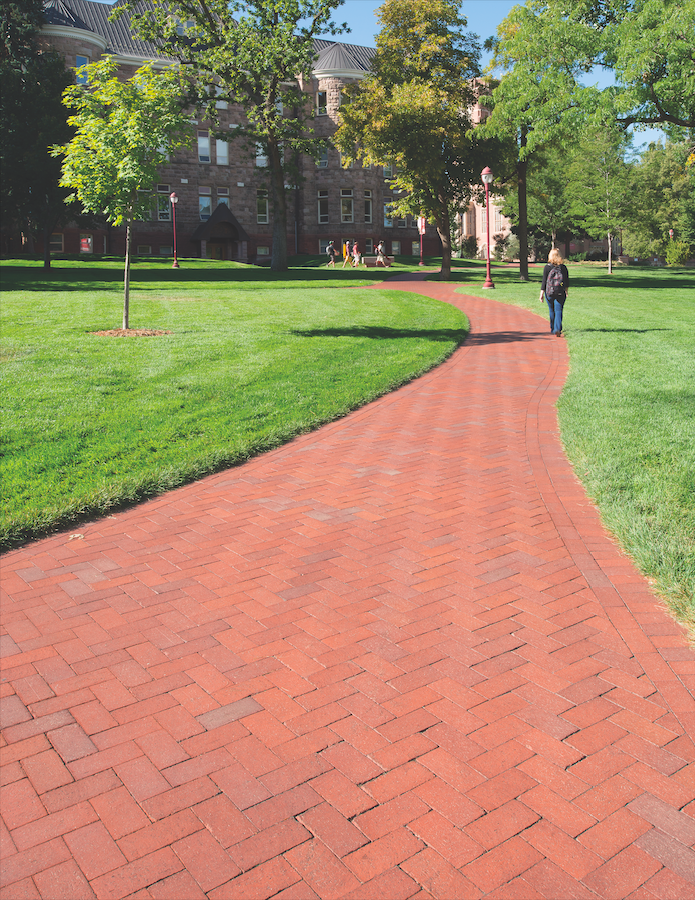
Decades after graduation, many former college students can still visualize their alma mater. The sights and sounds of campus make for heart-warming memories. Whether it was the distant sound of the band practicing for the big game or the iconic buildings and landscape on the property itself, every university has a unique look and feel that is a powerful part of its tradition.
Due to the constant traffic from thousands of students, the landscaping and outdoor amenities of modern campuses require regular maintenance and are constantly changing. However, the traditional look and feel of these campuses are consistent. This environment exudes a pleasant nostalgia.
How?
In many cases, time-honored, traditional construction materials such as brick are used for the new construction of walkways, patios, flower beds, fountains and other outdoor amenities on campus and in other, high-traffic areas.
“The history of using brick for landscape enhancement such as walking paths and other spaces goes back to ancient Rome,” said Britt Stokes of Acme Brick. “There are also many brick structures, such as the streets of the early cities that have existed for centuries and continue to add charm to modern-day architecture. However, the brickmaking process has improved over the years, allowing the introduction of different types of brick.”
According to this recent article, “Despite outward appearances, not all bricks are alike, nor are they all used for the same purpose. For instance, did you know that bricks used for building vertical structures contain holes? These bricks—face bricks or structural bricks—come in a variety of types, all designed to ensure a structure’s sturdiness. Generally, they’re used for the construction of homes or walls.
Landscape architects know that not all brick contain holes. For example, brick pavers, which are both heavier and stronger, are designed to lay flat on the ground.
The constant use of walkways and other outside amenities of a typical college campus require sturdy construction materials. Many planners have opted to use clay pavers. Solid clay paving brick are hard-fired in computer-controlled kilns at high temperatures. Hard-firing fuses the clay particles for maximum strength as well as stain resistance and rich, natural color. Crucially brick pavers are impervious to ultraviolet radiation, which often causes artificially colored concrete pavers to fade.
When clay pavers are laid in a flexible paving system, their individual strength is further enhanced by a phenomenon known as interlock. A successful flexible paving installation distributes load evenly through the interaction of pavers, jointing sand, and paving bed. Interlock requires only simple tools, inexpensive bedding materials, readily available equipment, and normal high standards of workmanship.
“In addition to college campuses, these pavers can add a distinctive charm to other areas such as retail malls, public buildings, parks and as a part of residential landscaping surrounding outside kitchen and fire features,” said Stokes of Acme Brick.
Concrete has been used for sidewalks and other high-use areas such as factory floors for generations. The most important reason is cost; concrete is cheaper than brick pavers. But as is often the case, this lower price tag lacks the charm and sophistication of brick. Here is a brief comparison from several online sources:
Thanks for stopping by! We’re constantly working to make Brick.com the best resource for your projects. We’d love to get your feedback about your experience today—it only takes about 60 seconds and helps us make improvements for you.